Mon-Fri (8am-8pm) / Sat & Sun (8am-6pm)
Mon-Fri (8am-8pm) / Sat & Sun (8am-6pm)
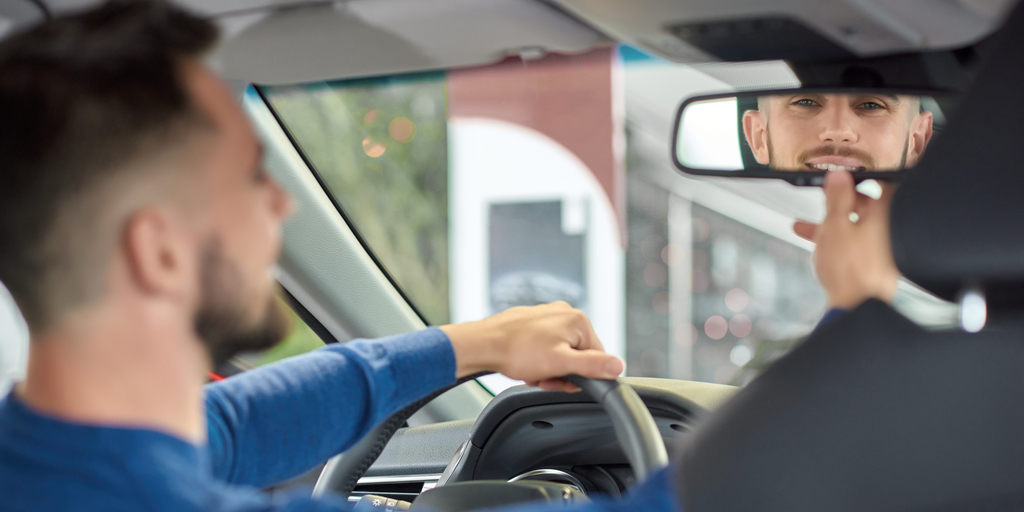
Check your mirrors, signal, then turn your head and look out the side window toward the lane you want before you move. That quick head check is how to check blind spots your mirrors can’t show you, and it matters every day on roads like GA-400 and I-285. At 1 ACT Driving Schools, we teach it as a lifelong habit, not a trick for test day. The road test just happens to be where a skipped check gets noticed fastest.
A blind spot is any area around your car that you can’t see in a mirror or through the windshield. Each side has one, usually just behind and beside the rear doors. A car, a motorcycle, or a cyclist can sit in that gap and never appear in your mirrors. Georgia DDS tells parents to coach teens to use the inside mirror for the rear, the side mirrors for the sides, and a head check for the area just beyond peripheral vision (DDS 40-Hour Parent/Teen Driving Guide).
DDS also suggests a drill that makes the gaps real. With the engine off, a helper walks backward from the front bumper until you can see their feet, and you mark that spot with a cone (DDS guide, Sessions 1 & 2). Repeat it at the rear and both sides. Once you’ve measured your own car’s blind areas, they stop being an abstract idea.
Follow the same order every time:
Two details trip people up. DDS tells coaches to have drivers look out the front side window, not the rear one, because the check covers the area just past your peripheral vision. New drivers also tend to turn the wheel in the direction they turn their head. Keep your hands steady, take your glance, and bring your eyes back to the road.
Want a second set of eyes? An instructor beside you can watch your head turn and your hands at the same time, which is hard to judge on your own. Our behind-the-wheel lessons start at 2 hours and are available across our Metro Atlanta locations.
Set your mirrors before you move, and again whenever someone else has driven the car. DDS says the inside mirror should frame the whole rear window, and the side mirrors should be angled to reduce blind spots and headlight glare. Our instructors use a simple method for the sides. Lean your head toward the driver’s window and turn the left mirror outward until you can barely see the flank of your car. Then lean toward the center of the car and do the same on the right.
Now a car passing you should slide out of the rearview mirror and into the side mirror. Then it should show up in your peripheral vision, with no gap in between. If it vanishes for a moment, turn the mirror out a little more. Unlike the head check, you only have to do this once.
Free download: Our one-page Blind Spot Check Card puts the five steps and the mirror method on a card you can keep in the glovebox. Get the card.
Any time the car moves sideways or backward into space you can’t fully see:
The same manual tells drivers to stay out of other people’s blind spots (Georgia DDS Drivers’ Manual). Trucks and buses have large side “No-Zones,” and if you can’t see the driver’s face in their side mirror, they can’t see you.
No. A monitor is a backup, not a replacement. IIHS studied these systems and found in 2017 that they cut lane-change crashes by 14 percent, and lane-change crashes with injuries by 23 percent (IIHS). That is a real gain, but it is far from a guarantee. A sensor can be dirty or switched off, and the next car you drive, such as a rental or a borrowed vehicle, may not have one. Treat the warning light as information and keep the head check as your decision.
A blind spot check covers one moment. Vision awareness is what you do the rest of the time: keep your eyes moving instead of locking onto the bumper ahead. DDS teaches a habit called commentary driving, where you say what you see out loud, such as “clear left, clear right, clear ahead.” It sounds silly in a driveway. On a real road, it forces your eyes to check each area.
Distance gives you time to look. DDS recommends at least a 3-second gap behind the vehicle ahead, and says to steer toward a target in the middle of your intended path. Early darkness and low winter sun make scanning harder from November on. Headlight glare behind you is one more reason to set your mirrors well. If fog or glare cuts your view, add space instead of squinting.
These are the habits our instructors correct most:
It shows up in every lane change, turn, and pull away from the curb, which is why the everyday habit is also the best preparation. DDS training materials list the blind spot check inside the lane-change steps, so build it into your practice from the first lesson rather than the week before the test. You don’t need an exaggerated head turn. Smooth and consistent beats dramatic.
When you’re ready to test, we offer the Georgia road test at our Alpharetta and Lawrenceville locations only. It happens at the school in our insured vehicle, with no trip to a DDS office, and a free retake if you don’t pass the first time. If you’re closer to another location, you can take your lessons there and test at one of those two. Our road test terms guide explains the vocabulary you’ll hear.
Ready for the road test? See how road test services work at Alpharetta and Lawrenceville, or find the location nearest you to start with lessons.
Knowing how to check blind spots comes down to one habit: mirrors, signal, quick head check, then move. Set your mirrors properly once, keep your hands steady, and treat any sensor as backup. The goal is for the routine to feel the same on a test route and on a Friday evening on I-85. If you’d like someone to watch your technique, our instructors are happy to help.
How far should I turn my head?
Far enough to see the area just beside and behind your door, through the side window next to you. It is a quick glance, not a long stare. Keep your hands steady so the car doesn’t drift.
Can I rely on my car’s blind spot sensor?
No. IIHS found these systems reduce lane-change crashes by 14 percent, which helps but leaves plenty uncovered. Use the light as a warning and still make the head check.
How often should I check my blind spots?
Before any move that takes the car sideways or backward: lane changes, merges, turns, pulling from a curb, and backing out. In between, keep scanning the road rather than fixing your eyes on one spot.
What if I only use my mirrors?
Mirrors leave a gap beside each rear door, and the head check exists to cover it. DDS teaches the check as part of the lane-change steps, so it’s a habit worth building before test day.
How do I know my mirrors are set correctly?
A passing car should move from the rearview mirror to the side mirror and then into your peripheral vision without disappearing. If there’s a gap, turn the side mirror outward a little more.
Where can I take the road test near Atlanta?
With us, at Alpharetta or Lawrenceville, in our insured vehicle with no DDS visit. Our other locations offer lessons to prepare.
Metro Atlanta's trusted driving school — DUI, defensive driving & driving lessons.
Book behind-the-wheel lessons with a DDS-certified instructor at any of our Metro Atlanta locations.
Schedule a Lesson




DUI License
#10102 Sandy Springs
#10424 Lawrenceville
#10391 Alpharetta
#10375 East Cobb/Marietta
#10429 Johns Creek
#10433 West Cobb/Marietta
DI License
#0002148 Sandy Springs
#0002362 Lawrenceville
#0002315 East Cobb/Marietta
#0002352 Alpharetta
#0002368 Johns Creek
#0002372 West Cobb/Marietta
DT License
#000664 Sandy Springs
#000673 Lawrenceville
#000697 Doraville
#000699 East Cobb/Marietta
#000730 Alpharetta
#000749 Johns Creek
#000755 West Cobb/Marietta
TPT License
#000673 Lawrenceville
#000730 Alpharetta
© Copyright 2026 1 ACT Driving School All Rights Reserved.