Mon-Fri (8am-8pm) / Sat & Sun (8am-6pm)
Mon-Fri (8am-8pm) / Sat & Sun (8am-6pm)
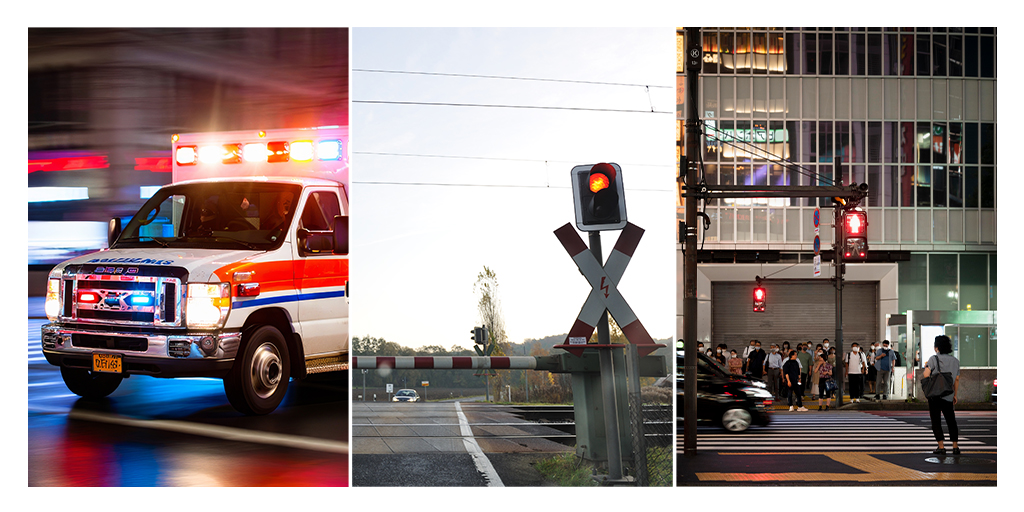
Flashing lights while driving give you only a moment to decide what to do. At an intersection, a flashing red light means stop, while flashing red lights at a railroad crossing signal an approaching train. School bus lights, emergency vehicle lights, and a flashing check engine light each call for a different response. This guide explains each flashing light you are likely to meet on Georgia roads, what it means, and how to respond safely. Knowing the difference protects you, your passengers, and everyone sharing the road.
| Light | Where you see it | What to do |
|---|---|---|
| Flashing red signal | Intersection | Stop like it’s a stop sign, yield, then go when clear |
| Flashing yellow signal | Intersection | Slow down, look both ways, proceed with care |
| Flashing yellow arrow | Left-turn lane | Turn left only after yielding to oncoming traffic and pedestrians |
| Alternating flashing red | Pedestrian crosswalk beacon | Full stop until pedestrians clear the crosswalk |
| Flashing red lights | Railroad crossing | Stop 15 to 50 feet from the nearest rail; wait until lights stop and gates rise |
| Flashing amber lights | School bus | Slow down and be ready to stop |
| Flashing red lights and stop arm | School bus | Stop and stay stopped until the bus moves or its lights go off |
| Flashing yellow lights | School zone sign | Reduced speed limit is in effect |
| Flashing yellow, amber, white, red, or blue lights | Stopped emergency or work vehicle | Move over one lane if safe; otherwise slow below the speed limit |
| Flashing check engine light | Dashboard | Pull over safely and call for help |
A flashing red traffic light means stop, and you treat it exactly like a stop sign. Come to a complete stop at the marked stop line. If there is no line, stop before the crosswalk. Look both ways, yield to pedestrians and other vehicles, and go only when the intersection is clear.
If every direction is flashing red, the intersection works as an all-way stop. The DDS manual says the usual stop-sign order applies: yield to pedestrians first, then first to arrive, first to proceed. Signals also flash when they malfunction, and you may see red in one direction and yellow in the other. Follow the color facing you. If yours is red, you stop, even if cross traffic keeps moving.
Pedestrian crosswalk beacons add one more version. At a pedestrian hybrid beacon (often called a HAWK signal), the lights cycle from flashing yellow to steady yellow to solid red. Then they change to alternating flashing red. That means a full stop, and you may go once pedestrians have cleared the crosswalk. The signal then goes dark until someone presses the button again.
A flashing yellow light means caution: slow down, look in both directions, and proceed with care. You do not have to stop. You are still responsible for yielding if another driver or pedestrian has the right-of-way. Treat it as a warning that the intersection needs extra attention.
A flashing yellow arrow works differently. It appears at left-turn lanes and means you may turn left after yielding to oncoming traffic and pedestrians. Oncoming drivers still have a green light, so the turn is not protected. Georgia DOT calls flashing yellow arrows its preferred left-turn signal for new upgrades, so you will see more of them each year. If one of these signals malfunctions, the left turn flashes red, and then you stop.
Flashing red lights at a railroad crossing mean a train is approaching, and you must stop. Georgia law requires you to stop within 50 feet, but not less than 15 feet, from the nearest rail when the signal is flashing or the gates are lowered. Stay stopped until the tracks are clear, the lights stop flashing, and the gates go up. Even then, confirm it is safe before you move. You can read the full rules in the DDS driver’s manual.
Never race a train to the crossing. If the crossing has more than one track, make sure every track is clear before you cross. At a crossing with no lights or gates, slow down, look, and listen for a train. Georgia’s statute says drivers at those crossings must slow to a reasonable speed and verify that nothing is coming.
Flashing amber lights on a school bus mean the bus is about to stop. Slow down, be ready to stop, and watch for children walking along or crossing the road. Once the lights turn red and the stop arm extends, it is unlawful to pass the bus while it loads or unloads. After you stop, stay stopped until the bus starts moving or turns off its signals and everyone has cleared the road.
Who has to stop depends on the road. DDS publishes this guide, and the center turn lane catches many drivers off guard.
| Road type | Who must stop |
|---|---|
| Two-lane road | All traffic, both directions |
| Two-lane road with a center turn lane | All traffic, both directions |
| Four-lane road without a median separation | All traffic, both directions |
| Road of four lanes or more with a center turn lane | All traffic, both directions |
| Divided highway of four lanes or more with a median separation | Only traffic following the bus |
The penalties are serious. A violation carries a mandatory court appearance, a fine of up to $1,000, and up to 6 points on your record. A driver under 21 who is convicted faces license suspension. The DDS school bus rules explain the full law.
Flashing yellow lights on a school speed limit sign mean the reduced school-zone limit is in effect. The posted number varies by school, so read the sign each time. When the lights are flashing, you drive at the lower speed. Children may be crossing, arriving, or waiting at the curb, and the flashing lights tell you that is likely right now.
When an emergency vehicle approaches with its lights and siren on, safely move out of its way. Georgia’s Move Over law covers vehicles that are already stopped. When you approach a stopped emergency vehicle with flashing yellow, amber, white, red, or blue lights, move over one lane if it is safe. If you cannot, slow below the speed limit and be prepared to stop. The law also protects stopped towing, highway maintenance, utility, and sanitation workers.
Work zones follow a similar idea. Work vehicles typically show flashing or revolving amber lights, and you must yield the right-of-way to them. Reduce your speed as you approach. Flaggers and flashing arrows may also direct you to merge, so keep your eyes up and your phone down.
Hazard lights flash all your turn signals at once to warn other drivers that your car is a problem. Use them when your car breaks down or you are stopped on a shoulder. Then get yourself and your passengers away from moving traffic if you can do it safely. Flashers make a stopped car easier to see, but they do not make it safe.
Do not use hazards as a substitute for a turn signal, and never as an excuse to park where parking is not allowed. Rules for driving with hazards on while moving vary by state, so check Georgia’s current rules before you do it.
A flashing check engine light is more urgent than a steady one. AAA says a flashing light signals an ignition malfunction, most likely an engine misfire. If the car is losing power, shaking, or giving off a strange odor, pull over as soon as it is safe. AAA also advises shutting off the engine and calling roadside assistance rather than driving on.
Dashboard symbols vary by make and model, so your owner’s manual is the best guide to every light on your panel. We can’t diagnose a car in a blog post, and we won’t try. What we can tell you is that any flashing warning light deserves a safe stop, not a “let’s see if it goes away.”
Knowing a rule and acting on it at 35 mph are different skills. DDS’s road skills test checks that you stop for signs and signals and yield the right-of-way. Our instructors practice these situations with students in real traffic, so you meet a flashing yellow arrow with an instructor beside you, not alone for the first time.
You can take behind-the-wheel driving lessons at any of our seven Metro Atlanta locations. Road tests are available at our Alpharetta and Lawrenceville locations only. See our road test services page for details, and our Georgia road test terms explained post if the vocabulary is new to you. If you already have a ticket for ignoring a signal, our Defensive Driving course may apply, depending on your court and driving record.
Q: Is a flashing red light the same as a stop sign?
A: Yes. Stop completely at the line, yield, and go when it is safe. If all directions flash red, treat it as an all-way stop and take turns in the order you arrived.
Q: What do I do if a traffic light is flashing because it’s broken?
A: Follow the color facing you. A flashing red means stop and wait until it is safe to proceed. A flashing yellow means you may proceed with caution.
Q: Do I have to stop for a school bus on the other side of the road?
A: Often yes. On two-lane roads and roads with only a center turn lane, traffic in both directions stops. On a divided highway with a median, only traffic following the bus must stop.
Q: How far from a railroad crossing do I stop?
A: Stop within 50 feet but not less than 15 feet from the nearest rail. This applies when the signal is flashing or the gates are down.
Q: Can I keep driving with a flashing check engine light?
A: No. AAA advises pulling over and shutting off the engine. A flashing light usually points to a serious problem, such as a misfire.
Q: What does Georgia’s Move Over law require?
A: Move over one lane when you approach a stopped emergency or work vehicle with flashing lights, if it is safe. If you can’t, slow below the speed limit and be ready to stop.
The color tells you what to do. Flashing red means stop, and flashing yellow means slow down and look. Nearly every other flashing light on the road, from school buses to railroad crossings, builds on those two ideas. When you are not sure what a light wants from you, slow down and give way.
If you would like an instructor beside you while you practice, we are here. Call us at 770-274-4223 or text 404-590-4570 to book a lesson at one of our seven Metro Atlanta locations.
Metro Atlanta's trusted driving school — DUI, defensive driving & driving lessons.
Book behind-the-wheel lessons with a DDS-certified instructor at any of our Metro Atlanta locations.
Schedule a Lesson


DUI License
#10102 Sandy Springs
#10424 Lawrenceville
#10391 Alpharetta
#10375 East Cobb/Marietta
#10429 Johns Creek
#10433 West Cobb/Marietta
DI License
#0002148 Sandy Springs
#0002362 Lawrenceville
#0002315 East Cobb/Marietta
#0002352 Alpharetta
#0002368 Johns Creek
#0002372 West Cobb/Marietta
DT License
#000664 Sandy Springs
#000673 Lawrenceville
#000697 Doraville
#000699 East Cobb/Marietta
#000730 Alpharetta
#000749 Johns Creek
#000755 West Cobb/Marietta
TPT License
#000673 Lawrenceville
#000730 Alpharetta
© Copyright 2026 1 ACT Driving School All Rights Reserved.